List of Posts

In the most recent entry to this blog, guest poster Jeff Raz left us off in Japan, so while we’re all there let’s just hop one country to our left and pay a visit to China and the Beijing Opera. (Or as we called it back in the good old days, Red China and the Peking Opera.)
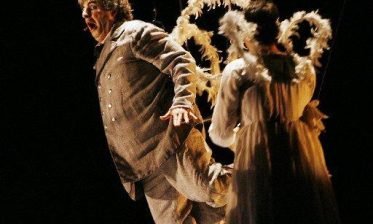
Please welcome guest poster Jeff Raz! This is just the first paragraph of his full and very impressive bio
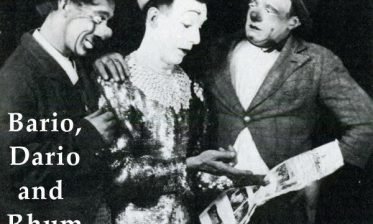
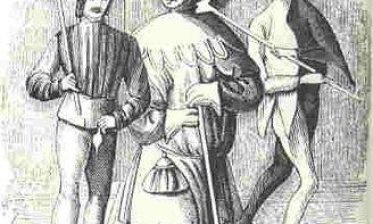
Fous et Bouffons: un Etude Physiologique, Psychologique et Historique (Fools & Buffoons: A Physiological, Psychological, and Historical Study)
by Dr. Paul Moreau
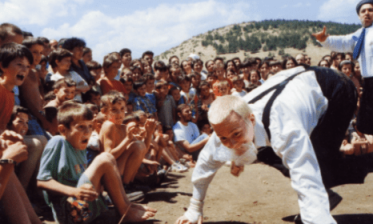
I don’t know much about this, but it might be right up your clown alley. The Manege Center for Circus, Music Hall and Street Performance, in collaboration with the Swedish branch of Clowns Without Borders and the Stockholm Academy of Dramatic Arts, is offering a one-year master’s degree program in Physical Comedy. Classes are in English and start January 2011. “Upon completion of the programme students will be qualified to work with Clowns without Borders internationally.” You might want to ask if “qualified” means “offered a job,” but certainly worth looking into.
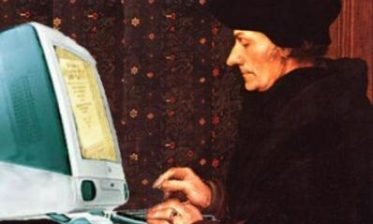
It turns out Erasmus is not just the name of a high school in New York City. Apparently before he was a high school — about 500 years before — he was also a famous philosopher.

We interrupt my onslaught of free books about medieval fools and jesters to bring you this important 50-second message from Germany’s top handyman; at least I think it’s from Germany. He’s definitely handy. I mean, sheesh, I can juggle and I can fix things, but I never thought about combining them!
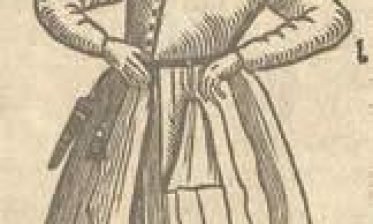
The standard entry on fools and jesters usually makes mention of Shakespeare’s jester characters, especially the fool in King Lear. It was Robert Armin (c. 1563 – 1615) who first acted the role as a member of the Lord Chamberlain’s Men, as well as such similar roles as Touchstone in As You Like It, Feste in Twelfth Night, Lavatch in All’s Well That Ends Well, and perhaps Autolycus in The Winter’s Tale, as well as comic parts in other Elizabethan dramas. In fact, Armin’s joining the company around 1600 is credited by some with Shakespeare’s increased interest in witty jesters.

The Delight Makers by Adolf F. Bandelier (1890)
A novel about Pueblo Indian koshare clowns
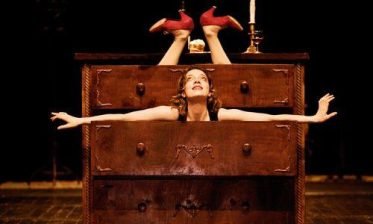
In the beginning (1889) there was Charlie Chaplin. And then it came to pass that 54 years later Chaplin took as his fourth wife 18-year-old Oona O’Neill, against the wishes of her father, playwright Eugene O’Neill. Despite the age difference they lived happily ever after and gave birth to eight children, the fourth being Victoria (born 1951).
We interrupt all these reports from San Francisco to bring you this emergency message. There was a Super Bowl yesterday. There were a lot of commercials. Advertisers paid $3 million for a 30-second spot. The least you could do is watch.

In writing about San Francisco on my last post, I mentioned the influence the San Francisco Mime Troupe had on the popular-arts performance scene there. If you’ve seen their work, you’ve probably wondered why they label themselves a mime troupe. The answer lies in their early years under the direction of their founder, R.G. Davis (photo, right). This manifesto on mime and pantomime, written by Davis in 1962, shows the troupe’s roots and still raises some interesting questions today.
TRANSLATE THIS PAGE
My first book (1976)
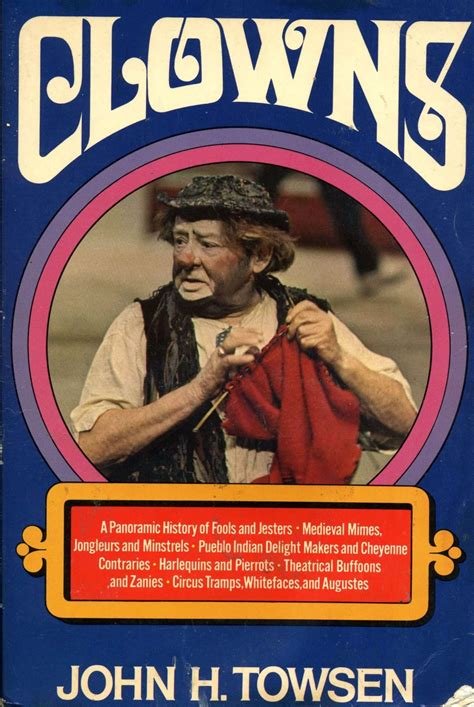
My book Clowns has long been out of print, but you can borrow it for two weeks at a time from the Internet Archive. More information is available here.
My second book (2015)

Visual and verbal humor for the cognitively and artistically curious! Available here.
“A book to treasure!”
—Bill Irwin