Tag: Mime
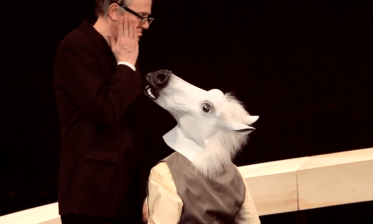
If I weren’t in Costa Rica right now I’d be seriously wishing I were in London. Even if you’ve never been and might never go, it’s good to know that the London International Mime Festival is now entering its 40th year. Since its inception in 1977, the festival has gone way beyond mime to encompass circus, clown, physical theatre, mask work, puppetry, and more. In the process, it has not only popularized a lot of deserving movement-oriented work, but has opened eyes outside the already converted. As the NY Times comments this week, “over four decades it has had a significant impact on British theater, disrupting the dominance of scripted plays —something that hasn’t quite happened the same way in the United States.”
First we had this post about mimes directing traffic in Caracas, Venezuela, and now by way of my old friend Jim Jackson comes news that the mayor of Paris is employing “nocturnal artistic intervention squads” to help quiet down rowdy late-night partiers.
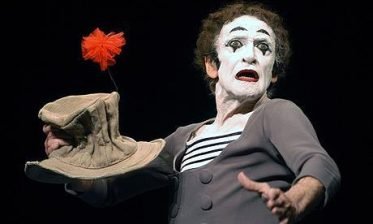
I suppose I could write a post about the virtues and limitations of mime training, but this isn’t it. Sure, I took a smattering of classes, studying with Reid Gilbert, René Houtrides, Tom Leabhart, and Moni Yakim (and salivating over Children of Paradise), but I never really took to mime. (Translation: I sucked at it.) So instead of a treatise, just a few hopefully amusing snapshots of mime’s public image over the years.
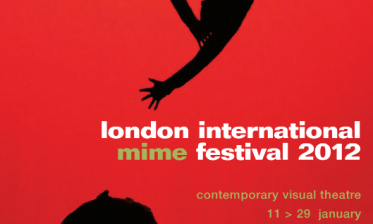
I live in New York and have this thing called a job, otherwise the London International Mime Festival would be a good excuse to visit The Big Smoke for nineteen days this January (as if I needed an excuse). If you’re closer to London and less tied down, you’d be crazy to miss it.
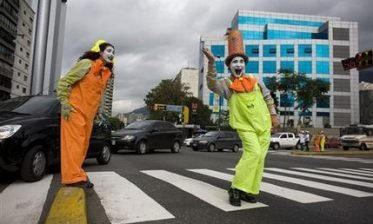
Associated Press, Caracas: Mimes gesture as they stand in a crosswalk in Caracas, Venezuela, Friday Oct. 7, 2011. The mayor of the city’s eastern district of Sucre has launched a unique program aimed to encourage civility among reckless drivers and careless pedestrians, putting 120 mimes at intersections to politely and silently scold violators. The campaign kicked off this week as mimes posted at busy intersections mocked people who jaywalked or acted brutish behind the wheel. (AP Photo/Ariana Cubillos)
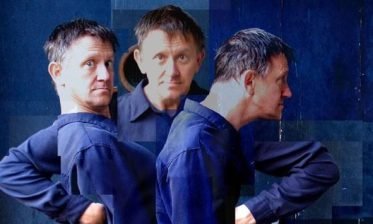
It takes more than a little bravery to tell an audience outright that you are going to explain to them how comedy works and that you intend to make them laugh a lot in the process, even suggesting that they don’t have much choice in the matter. But if they don’t laugh, you lose on two counts. And it takes a lot of talent, training, and practice to pull it off as well as Jos Houben did Tuesday night in New York at an evening hosted by the Alliance Française as part of their Crossing the Line performance series. Yes, lots of laughs and a standing ovation.
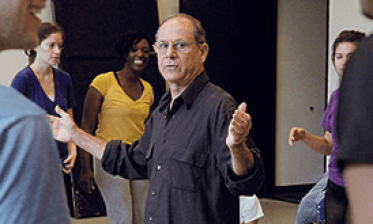
The notion that physical comedians and other movement artists might have something to teach traditional actors goes back at least a century, when such innovative directors as Jacques Copeau in France and Vsevolod Meyerhold in Russia hired accomplished clowns and variety performers as guest instructors. In the United States, this became a trend in the 60s and 70s as “experimental” theatres sought to break the confines of the fourth wall and Stanislavski method acting to forge more theatrical performance styles.
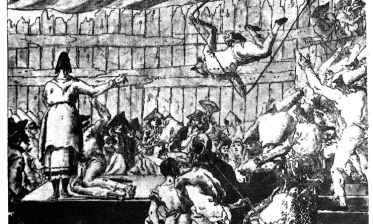
When I was writing Clowns, these were the books I consulted the most for my section on commedia dell’arte:
• Masks, Mimes & Miracles by Alardyce Nicoll
• The World of Harlequin by Alardyce Nicoll
• The Italian Comedy by Pierre Duchartre
• The History of the Harlequinade by Maurice Sand
• Scenarios of the Commedia Dell’Arte by Flaminio Scala
• The Commedia Dell’Arte by Giacomo Oreglia
You’ve probably already seen most of the mime-y shtick these guys do, but their high energy and inspired silliness make it fresh and funny. Thanks to Jeff Seal for the link.

“Live from Paris” last April, that is, where I was already undercover on the Linder and Etaix capers when I got a coded message from one Michael Evans, an operative unknown to me but apparently a go-between for a character from the 70s who at that time went by the unassuming name of Lou Campbell. I was in Paris, I had nothing better to do (hah!), and before I could say fromage I’d been given the assignment to track down legendary Japanese pantomimist Mamako Yoneyama, rumored to be hiding out in that City of Light Mimes. Evans (if that’s his real name) had first met Yoneyama — code name Mamako— at the 1974 International Mime Festival at Viterbo College in Lacrosse, Wisconsin, organized by yet another “Lou Campbell.” Or was he in fact the same person?? Evans’ rambling confession about that festival — an event whose foreign ideas about movement theatre forever corrupted the minds of a whole generation of impressionable Americans in tights —has finally been released thanks to the Freedom of Information Act, and now the general public can view it here, including incriminating sketches and notes such as these:
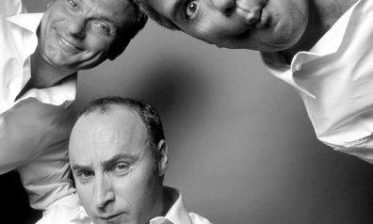
If you spend your days in the United States, chances are you’ve never heard of the Catalonian physical comedy trio, Tricicle. In Europe, however, they’re a well-known brand name, almost a small industry, having performed extensively in major theatres and festivals for over thirty years, as well as on tv and in movies, and even as part of the opening ceremonies for the 1992 Olympics here in Barcelona. Founded by Joan Gracia, Paco Mir and Carles Sans in 1979, they expanded their international reach in 1988 by adding a second 3-man company (photo, right), known as Tricicle-2 or Clownic, which performs pieces from the by-now large Tricicle sketch repertory, and which is who I saw last night.

In writing about San Francisco on my last post, I mentioned the influence the San Francisco Mime Troupe had on the popular-arts performance scene there. If you’ve seen their work, you’ve probably wondered why they label themselves a mime troupe. The answer lies in their early years under the direction of their founder, R.G. Davis (photo, right). This manifesto on mime and pantomime, written by Davis in 1962, shows the troupe’s roots and still raises some interesting questions today.
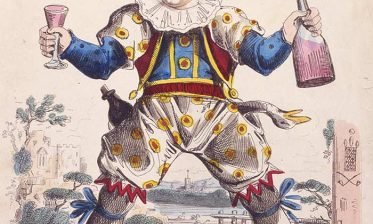
Today I introduce yet another new feature to this blog, a complete book in the form of a pdf file suitable for reading online, downloading, or printing. Because of legal issues, most if not all books presented here will be from the pre-copyright era, roughly a century or more ago, and therefore of a historical nature.
TRANSLATE THIS PAGE
Workshops & Other Events
My first book (1976)
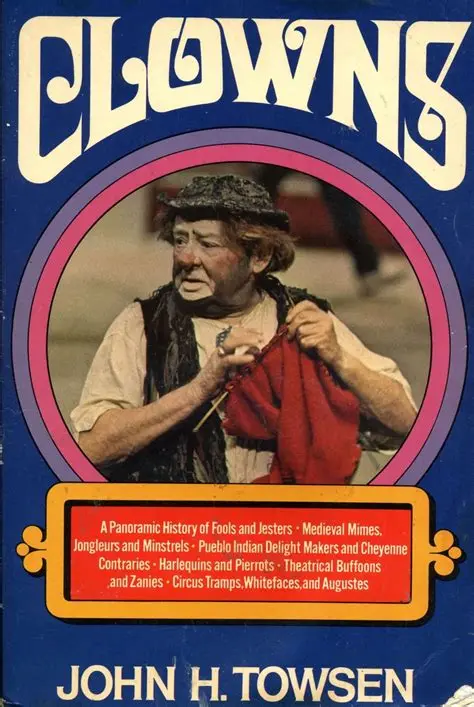
My book Clowns has long been out of print, but you can borrow it for two weeks at a time from the Internet Archive. More information is available here.
My second book (2015)

Visual and verbal humor for the cognitively and artistically curious! Available here.
“A book to treasure!”
—Bill Irwin