Tag: Technique
Hey, I’m 63 and still going strong, still doing triathlons and still teaching physical comedy, but I’m nothing compared to this grand dame, Johanna Quaas.
One of the things I like the most about Jackie Chan is his imaginative use of ordinary household items in his fight and chase scenes. In this clip he talks about it and shows a few examples.
Here’s an interesting clip of Jackie Chan explaining how he enhances some of his less spectacular falls.
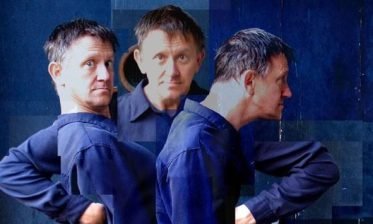
It takes more than a little bravery to tell an audience outright that you are going to explain to them how comedy works and that you intend to make them laugh a lot in the process, even suggesting that they don’t have much choice in the matter. But if they don’t laugh, you lose on two counts. And it takes a lot of talent, training, and practice to pull it off as well as Jos Houben did Tuesday night in New York at an evening hosted by the Alliance Française as part of their Crossing the Line performance series. Yes, lots of laughs and a standing ovation.
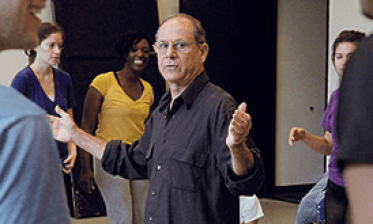
The notion that physical comedians and other movement artists might have something to teach traditional actors goes back at least a century, when such innovative directors as Jacques Copeau in France and Vsevolod Meyerhold in Russia hired accomplished clowns and variety performers as guest instructors. In the United States, this became a trend in the 60s and 70s as “experimental” theatres sought to break the confines of the fourth wall and Stanislavski method acting to forge more theatrical performance styles.
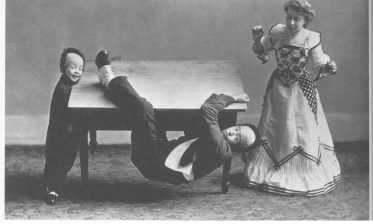
Pure acrobatics operates in a precise world where time and 3D space intersect in ways even Einstein could not have imagined without vaudeville. As my old Russian circus teacher Gregory Fedin put it, “if you are able to see space, the acrobat has to go through it… go with the curves, like the tracks of a railway.”
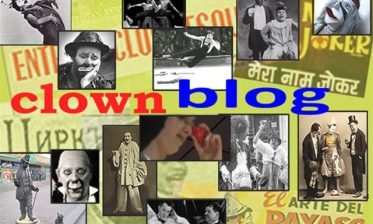
I had the pleasure to meet British clown performer and teacher Jon Davison this summer in London and to speak with him about his research into the workings of the performing clown. For the past couple of years he has been undertaking an International Clown Research Project, in residency at London University and at the Escola de Clown de Barcelona. He is in the process of compiling a sort of Encyclopaedia of Clown. I say sort of encyclopaedia, because part of what he’s doing is analytic writing and part of it is “a performance designed to test, compare and demonstrate the wide variety of forms and structures in clown performance.”
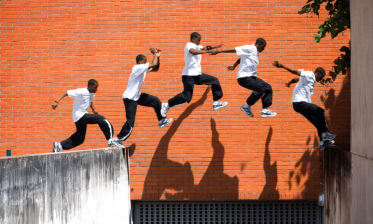
I guess it’s a generational thing, but when I mention parkour to anyone over 40, I usually get a blank stare, which if nothing else makes me feel young and in the know. If you too are going “huh?” just think of those videos you’ve probably seen of ridiculously agile teenage daredevils — Spidermen without the web — jumping on, over and off walls, railings and other structures that get in their way. They are called traceurs presumably because they trace a path through space while leaving only a faint imprint.
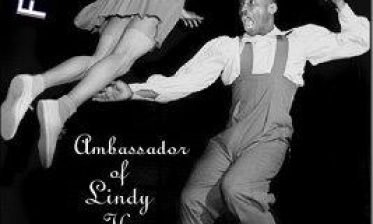
I’m no expert on Frankie Manning or the lindy hop, but both are worth knowing about regardless of any indirect connection with physical comedy. Manning made it to just short of his 95th birthday, active almost to the end, and left behind a lifetime of achievement in developing and popularizing the lindy hop. The NY Times obituary is a good starting point, but also check out the Frankie Manning web site and the Wikipedia entry.
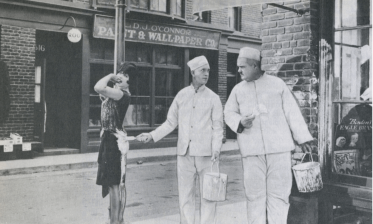
This article with the overly-cute title, which I wrote for Yale Theater magazine some 22 years ago at the behest of editor Joel Schechter, is still the best intro to where I’m coming from on the subject of physical comedy. This was about 11 years after I wrote Clowns, but this time around I had more fun with the writing and tried to make a wider range of connections between performance and the so-called real world. I still like the article, and I welcome your feedback on it.
TRANSLATE THIS PAGE
Workshops & Other Events
My first book (1976)
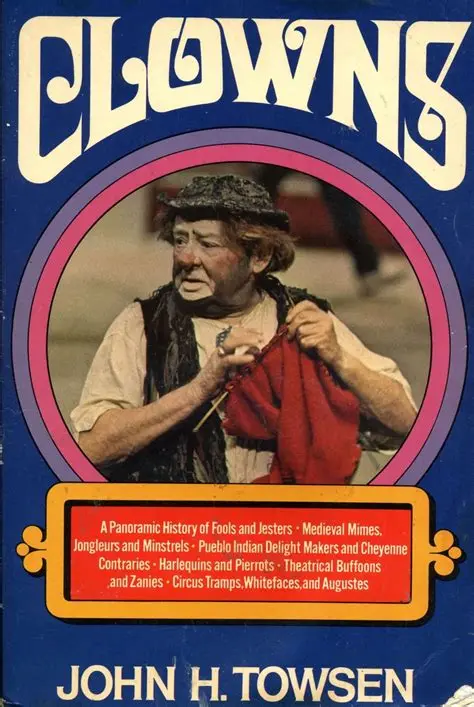
My book Clowns has long been out of print, but you can borrow it for two weeks at a time from the Internet Archive. More information is available here.
My second book (2015)

Visual and verbal humor for the cognitively and artistically curious! Available here.
“A book to treasure!”
—Bill Irwin