List of Posts
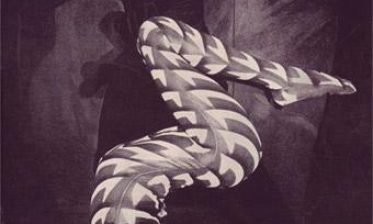
The typical contortion act — you know, with the platform and the mouthpiece and the 13-year-old girl doing a Marinelli bend — puts me to sleep. And then there’s the snake dance of French performers Janik & Arnaut — Janine Janik (1931 – 1985) & Christian Arnaut (1912 – 2003). This isn’t exactly physical comedy since they’re not going for the laughs, but the partnering work is amazing: not just the unique positions, but the sinuous flow of the snake around the charmer’s body. In most partner acrobatics, the base is muscling a lot of the moves; here, much of it is accomplished with little or no use of Arnaut’s hands, much less his biceps; he guides more than he lifts.
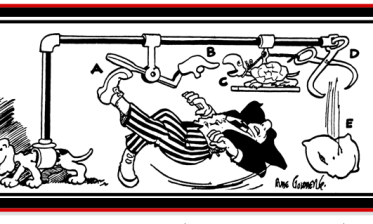
Rube Goldberg was an inventor and cartoonist born the same year as Max Linder (1883), which is to say a few years after Mack Sennett and a few years before Charlie Chaplin and Stan Laurel. He drew popular cartoons of elaborate gadgets that performed simple tasks in the most convoluted way imaginable.
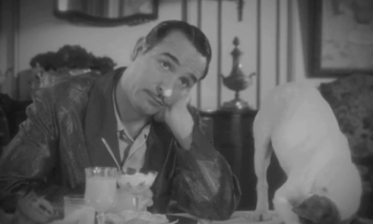
I first previewed the new silent movie, The Artist, when it surfaced at the Cannes Film Festival in May, and then reviewed it when it opened in New York on Thanksgiving weekend, but now folks who know about these things are saying it might actually snatch the best-picture Oscar. We’ll have to wait until January 24th for the nominations, but meanwhile The Artist has won best picture in Boston and San Francisco, copped six Golden Globe nominations, garnered four nominations from the Vancouver Film Critics Circle, and was named by the Producers Guild of America and the Houston Film Critics Society as one of the year’s top 10 movies. As we get closer to the February 26th Academy Awards, money, reputations, and artistic correctness will all be at stake, so of course the opinions are flying!
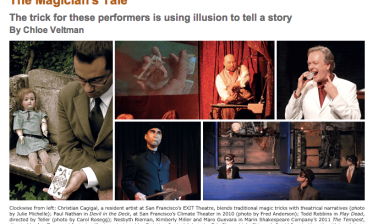
I was just about to move on from the topic of magic (see three previous posts) when Billy Schultz sent me this article by Chloe Veltman from American Theatre magazine. Nothing about physical comedy, but a lot about magic as theatre.
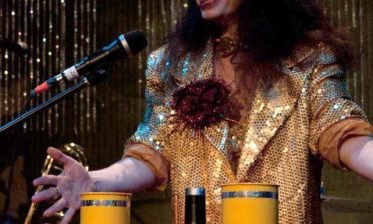
When I knew that Ben Robinson and Julian Olf would be contributing their writing on magic as guest posts, I asked my friend Tanya Solomon to recommend some good comedy magic to me. I’ve always had some interest in magic, but never pursued it and basically know very little. Tanya on the other hand is a veteran New York variety performer who combines all sorts of clowning, dance, and magic in her performances — plus she even works part-time in a magic store! When she came back to me with a thorough list of recommended videos, I thought it would be great if she would expand it into another guest post for the blogopedia. Take it away, Tanya (but don’t make it vanish)…. —jt

We continue our look at magic technique with this revealing analysis of the performance of the great magician, Cardini, by an old colleague of mine, Julian Olf. This article first appeared in a 1974 popular entertainments issue of The Drama Review (TDR) that I worked on as an editor in my grad school days at NYU. Even back then I realized that Julian’s take on magic as a form of acting offered a fresh perspective, and re-reading it today only reinforces that opinion. So happy to have tracked Julian down, and much thanks to him for kindly granting permission to share his work with readers of this blogopedia.

Ben Robinson is both a master magician and an historian of magic, author of Twelve Have Died: Bullet Catching, The Story & Secrets and of The MagiCIAn: John Mulholland’s Secret Life, as well as numerous articles for major magic publications. Just last month, Ben’s decades-long research into the use of magic in silent films came to fruition with publication of his latest book, Magic and the Silent Clowns — a subject that had received scant attention until Ben’s work. Concurrent with that, Ben helped curate a fascinating show at New York’s Museum of the Moving Image entitled Magicians on Screen, including both a magic performance by Ben and a lecture-demo on the subject of magic and the silent clowns. In fact, Ben had first proposed the idea to the museum back in the 80s. Patience is indeed a virtue — though persistence sure helps! This blogopedia is very pleased to be able to share the first chapter from Magic & the Silent Clowns, and to be able to match Ben’s enthusiastic prose with a few video clips.
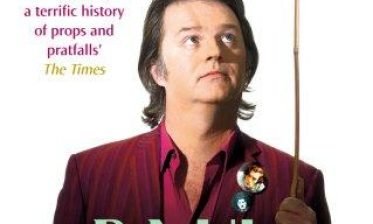
There are a ton of books about silent film comedy, many of them excellent, but they’re not written by performers. Paul Merton, author of Silent Comedy, is on the other hand a popular British comedian — mostly improv and stand-up, rarely silent —with a love for the heyday of slapstick. He has even done several lecture tours on the subject, bringing screenings with live music to theatre festivals and other venues throughout the U.K. In the past two years he has produced two documentaries on early film (not just comedy) for television: Paul Merton’s Weird and Wonderful World of Early Cinema (BBC Bristol, 2010) and The Birth of Hollywood (BBC2, 2011). He has also done an interactive presentation on early British film comedy for the British Film Institute, which you can view online here.
Here’s how this here blogopedia works: I come up with great ideas for posts much faster than I can research and write them. (Yes, I have a life.) For every post you see, there are five in some stage of development, which may or may not see life. The sidebar item, “Coming Soon-ish or Later-ish on the Blogopedia,” is merely the tip of the iceberg.

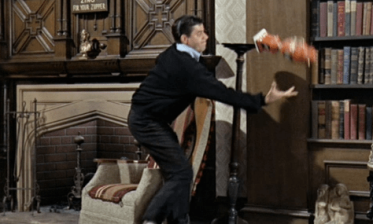
I recently gave up my cable tv subscription so I don’t know when I’ll ever see this, but there’s a new two-hour documentary on Jerry Lewis airing tonight (December 17th) at 8 p.m. and at midnight on Encore. The network is also dedicating much of today’s afternoon programming to a Jerry Lewis marathon, broadcasting films including The Bellboy starting at 1:50 p.m. I imagine the documentary will be shown again in the future, given the name of the channel.
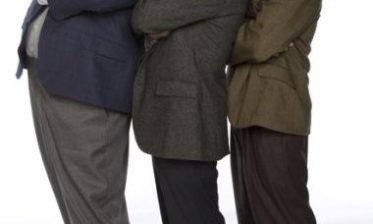
It doesn’t open until April 13, 2012, but the first trailer for the new Three Stooges movie is out. With our iconic childhood heroes creepily leering after nuns and making an appearance on the Jersey Shore reality tv show, it’s clear we’re not in Kansas any more. Iconic, yes; moronic, very likely; ironic, no.
According to co-director Peter Farrelly, “They are Moe, Larry, Curly as you remember them. It’s not a biopic. It’s the episodes just as you saw but we rewrote, we have all new episodes. We have three episodes. Technically, each episode picks up where the last one left off. Each one begins with its own theme, so it’s about an hour and 25 minutes. Three episodes, fun, old-fashioned, but it takes place present-day, and they look, dress and sound like the Three Stooges.”
Stephen Colbert hosts David Hallberg from the American Ballet Theater, first American to perform with Moscow’s legendary Bolshoi Ballet, and joins him and Hee Seo in a selection from Tchaikovsky’s The Nutcracker. Not uproarious, but you have to give Colbert credit here — better ballet chops than you’d expect from a stand-up comic!

When I run into Hilary Chaplain, an old friend and fellow New Yorker, my usual greeting is “Oh, I didn’t know you were back in the country.” As a popular theatre clown with a one-woman show and as a teacher of clown and physical comedy, Hilary is in demand at festivals and variety theatres all over the world. It was on these travels that she became acquainted with Spy Monkey, and her enthusiasm about their work led not only to this guest post, but also to her bringing them to New York to conduct workshops. You can read more about Hilary here, and if you’re anywhere near New York next weekend (Dec. 8–11), catch her show, A Life in her Day, as part of the Voice 4 Vision Puppet Festival at the Theatre for the New City. —jt
TRANSLATE THIS PAGE
My first book (1976)
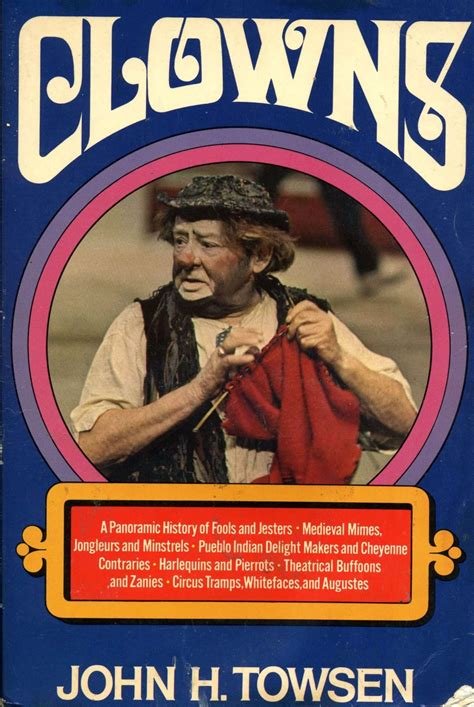
My book Clowns has long been out of print, but you can borrow it for two weeks at a time from the Internet Archive. More information is available here.
My second book (2015)

Visual and verbal humor for the cognitively and artistically curious! Available here.
“A book to treasure!”
—Bill Irwin